Saturday, August 27, 2016

St Joseph's Church History

The terror of tigers overwhelmed the whole of Malaya in the 19th century. Father Mauduit had himself tackled these man-eating cats even till his last days at the Mission Station. These flesh-consuming beasts preyed on susceptible Chinese coolies who worked in fields which were fenced by the jungle walls. There was no telling what hid behind the trees, and the beasts were not selective about their next meal, whether they were Christians or not. 
Father Perie here gives a most chilling account of an attack on one of his Christians.
"One Sunday, at about 10 o'clock in the day, one Christian came to me saying, 'Father, a tiger has eaten up Kam-ko-Pe.' I called for helpers with guns, axes and picks, and we went (to the scene). A man said that Kam-ko-Pe, while returning home from mass, passed in front of his pigsty and found that one of his pigs had disappeared. He shouted to his son in the house, 'A tiger has taken the pig.' And without telling anyone, he went with a big knife to the place where the tiger would have to pass to return to the forest. He was hoping to find the carcass of the pig. As soon as Kam-ko-Pe reached the woods, they heard a shout, and then a scream. The son heard and understood it all. 'My father is dead,' he said. The boy wanted to run to his father's aid but was restrained by the people.
"At the entrance of the forest, we fired our guns to frighten off the tiger. The hat of the poor Chinese attracted our eyes. It was there that the tiger took the man. It was eating the pig when it heard Kam-ko-Pe (approaching). And thirsting for blood, the tiger left the first victim to eat the man. After a few steps, we noticed some blood and a few pieces of clothing. So, we were sure of his death. Then we saw more blood and a bone with some flesh. Surely, the tiger was here. The fright was general among the hunters because everyone feared that the monster would jump at him. 'Kam-ko-Pe is here,' shouted one of my men. Indeed, next to the trunk of a tree, lying half devoured was the body of the unfortunate Christian, and it was difficult to recognise. Immediately, with some branches, we made a stretcher to carry the remains back for burial."
The Christians in the middle of the jungle lived in constant danger. If it was not the hoeys, it would have been the snake or the tiger that would cause hurt or even death. Sadly, there was still a more painful reality as far as the laws of the jungle was concerned - the life of a coolie was worth little. In one incident, a Christian coolie was carried off by a tiger. The monster, still clutching the poor soul in its jaws, leapt over a river and hid the body of its victim in some bushes. The Chief of Police for Bukit Timah came to know of the incident and forbade Father Perie to remove the body for burial...
"The chief of the police of Bukit Timah however forbade us to touch the body, wanting to hunt the tiger near the victim. (Despite) this) we found the body and carried it on branches to the church for burial. But the police stopped us. They wanted us to return the body to the forest where we found it. But I, the priest (of the parish), refused and sent my catechist to the Chief of Police, and the corpse went to church.
" The Chief of Police became very angry and was quite against me. I ordered the dead body to be put in front of the church, with the Christians in charge of watching over it. Soon I saw the Chief of Police coming with seven policemen. I was not afraid, but my Chinese friends were. I came down when the English policemen arrived at the door. I invited him (the Chief of Police) to my room. He accepted, and knowing of his love for brandy, I asked my servant to bring two glasses and a bottle of alcohol. I poured the cognac, and my visitor drank it quickly. I was saved. Politely, I told him that the law forbade the touching of the bodies of those killed by knives or suicide, but no one leaves the bodies of persons who had drowned in the water, and was not the law to apply in this case?
"The Englishman said, 'I understand, but had we killed the tiger, its skin had the value of one hundred dollars, and the newspaper would report this fact.' I gave him a glass of brandy and he was pleased with me. (Then) I asked if he would like to see the wounds of the poor victim, he agreed, and we came down. The Chinese who came to see were very anxious. They were happy to see the policemen leaving. They were afraid that I was going to be imprisoned. But now, the Chief of Police shook hands with me and left."
In colonial Singapore, only the "White Man" was worth anything, just as in other colonies of the time. Clearly, the Christian Church had a most important role in the lives of the ordinary Chinese in such countries.
Besides preaching the gospel, Father Perie found that he had to teach and show his flock that every one of them counted, and they were equally important and deserved a measure of dignity.
Source: http://www.straitstimes.com/opinion/tiger-tiger-tigers (extracted on 28 August 2016) 


The priest who started a farm and rebuilt the church
Born in the year of the Chinese Revolution, Father Joachim Teng was ordained in 1937 and posted to St Francis Church, Malacca. He moved around in Malaya till the end of the war when he ended up in Taiping, his last post in Malaya, before arriving in Singapore in 1949.
In April that year, Father Teng stepped into St Joseph's, where he would remain for almost two decades. Almost immediately, he demonstrated his fierce tenacity and dogged determination to visit all the outposts attached to St Joseph's as well as to teach in the St Joseph's Sino-English School himself, for at least two hours daily, after the school's English-language teacher left. He had two classes of 50 boys and girls.
Father Teng then took on the gargantuan task of building a new church for his growing congregation. The old church could seat only up to 250 people. By 1950, many had to stand on the sides during mass. He built the new church himself, as he was his own contractor. This new edifice would seat four times more people than the old one. He actually supervised his own masons and carpenters.
Father Teng also started an annual fun-fair during the Feast Day to raise funds for his new church and various building projects. And in so doing, he started the annual Food and Fun Fair tradition which is still organised till this day. And before the cement of the new St Joseph's could dry, he started building the Catholics of his Mandai outstation their own church.
In the same spirit as his MEP (the missionary group Missions Etrangeres) predecessors, Father Teng was a true missionary in modern times. As he spoke the Teochew dialect well, he had no problem communicating with the people in the district. So, he started visiting families who had settled around the church. And they would walk up to his house and have a chat with him through the night after a hard day's work, just as it was during the days of Father Mauduit. No one should wonder why the years Father Teng sojourned at St Joseph's were also the period the parish reached the apex of its development.
Father Teng left on Jan 24, 1972, for St Stephen's Church in Salim Road where he would stay for the next 10 years before retiring. He also completed the building of this church. He died on Feb 13, 1994, at the age of 83 at Bethany Home (next to the then Little Sisters of the Poor) in Upper Thomson Road.
FRUIT FROM THE EARTH
One way in which Father Teng generated much needed revenue for his parish was to plant fruit trees in the church's compound. Fruits like durians and rambutans were sold and the income went to the maintenance of the parish.
Before the new church was built, Father Teng also kept goats and cattle on the church compound. And these livestock, while they were still around, had the freedom to roam about, even up to the steps of the church. St Joseph's was then an old rustic countryside church with a parish community of simple people. The cattle were transported down from Malaysia and were kept in front of the church where the big carpark is today.
From these livestock, Father Teng had milk which he sold or made into butter for sale. Unfortunately, though, this parish dairy-farm business did not last long. Father Simon Yim recalls very well the tragic end of this "Bull Story".
"Father Teng was nearly killed by the bull. The bull charged at him. (Fortunately, Father Teng was alerted when) the children shouted at him, (and he managed) to hold on to the bull by the horns. But the beast lifted him and threw him against the trunk of a coconut tree which left him unconscious. The bull then "went in for the kill" and charged at Father Teng (while he was still on the ground). The children (seeing the danger), shouted at Ah Soon (for help). Ah Soon (came quickly. Seeing the situation), he shouted the bull's name. It stopped in its tracks. And that saved Father Teng! Ah Soon was the one who fed the cattle daily and they recognised him." 

Following this near-death event, Father Teng got rid of the cattle and goats. Besides, after the British pulled out, many soldiers who lived in Chestnut Drive had already left, reducing the demand for his dairy products.
Also, when health inspectors started surveying the area at this time, they found Father Teng's livestock and told him to remove the animals. Consequently, he gave his goats to the surrounding people, and some to the people of Mandai. He sold the cattle. There were six cows and a bull. Father Teng had wanted the herd to multiply for its milk, not its meat. And there ended Father Teng's "St Joseph's Farm".


A Chinese Christian marriage

During Father Perie's stay in Bukit Timah, the Christians of the hill multiplied, and many more marriages were solemnised, especially during feast days. Some of the girls of the Station were sent to Town to the Convent of the Sisters of the Holy Infant Jesus. There, the nuns prepared the girls for baptism. And when they came of age, marriages were arranged for them to Christian men. In Town, the Sisters ran an orphanage, a school for the young girls from Town, a boarding house, a refuge for destitute women, as well as a hospital.
Father Perie was not just a mere minister in a marriage of his Christians, he was the loco parentis. It was a Chinese custom in those days that parents arranged marriages for their children, and the male party had to "pay" a wedding basket. In the Mission, there were many young men who had come from China to make a living, and were without a single relation. And as Father Perie became their paternal custodian, he was obliged to make the customary arrangements for the marriage, which included discussing...the wedding basket.
"When I wanted to marry (give into marriage) one of my Christian boys, I had to go to Town to ask for a convent girl, bringing with myself the young man. A Religious (nun) (would then) call a young girl. They would then talk and, after eight to 15 days of prayers and reflection, both gave or refused their consent to the superior in charge. The parents of the young man and I would then have to decide what to give for the wedding basket."
A Christian wedding in Bukit Timah, like all Chinese weddings, must include the customary Chinese dinner...
"The wedding day is always a big feast day for Chinese pagans or Christians. All the parents and friends would be invited, and I have seen tables for 150 people. If they have many invited, they would be considered 'high class' and would have more friends. At the wedding dinner, everyone must give at least half a dollar. The men are always separated from the women. I was invited often to bless wedding dinners. There were no tables, nor chairs, nor benches, but some big square mats (were placed on the ground, taking the place of tables). On them were placed for each person two small sticks to eat the meat (chopsticks), a wooden spoon to drink the gravy and a cup to drink the rice alcohol or brandy. The food is placed on plates in the middle of the mats. All the meat is cut into small pieces. Taking turns, each would take a piece of meat and a spoonful of gravy and drink a cup of wine. They eat a lot of meat prepared with chilli; so hot that I was never able to eat any. At the end of the meal, they eat a bowl of rice. When I was invited, they prepared for me roasted meat and rice. After the meal, the pagan man takes his bride, holding her hands and presents her to the friends. They go around, saluting everyone. Then, the oldest one who knows how to write, takes a big piece of paper to certify the wedding for the archive of the family. "
Christians, being the minority on the island, faced many difficulties. And this included finding a Christian partner for marriage. But more often than not, one of the partners would not be a Catholic, and this created many problems for Father Perie. This cannot be more clearly illustrated than when one of his catechists chose a non-Christian girl to be his life partner. Father Perie instructed and baptised her. A great number of the Chinese pagans packed the church on the wedding day.
"The church was full. I gave a good sermon on marriage and they listened well. After the mass, I blessed all the mats for dinner. In the evening, the 12-year-old sister of the bride, Gek-Mio, who had followed the catechism of her sister, wanted to remain with her and to be baptised. The father, who was a strong pagan, was furious. I talked to him, telling him that I did not push his daughter to do so, (but at the same time reminding him that) she was already 12, and has the freedom to decide what she wanted to do with her life, according to English law. The father later died a pagan, and Gek-Mio became a fervent Christian, and a good mother..."

Sunday, February 16, 2014

OUR PAGAN RESISTANCE TO THE OTHER WORLD- A PREOCCUPATION WITH WORLDLY PURSUITS

OUR PAGAN RESISTANCE TO THE OTHER WORLD

2014-02-09
Sometimes while presiding at the Eucharist or preaching, I scan the faces in the front pews. What do they reveal? A few are eager, attentive, focused on what's happening, but a goodly number of faces, particularly among the young, speak of boredom, of dram duty, and of a resignation that says: I have to be in the church just now, though I wish I was elsewhere. These reactions are, of course, understandable. We're human after all, flesh and blood, and when we try to focus on the world of spirit or on what relativizes flesh and blood, mortality and self-sacrifice, we can expect that most times the reality of this life will trump the promise of other world.

Sometimes, gazing at those faces staring back at me in church, I'm reminded of a scene that Virginia Woolf describes in her novel, The Waves.  The scene is a chapel in a boarding school in England where one of the churchwardens is giving the students a spiritual admonition during a worship service. This particular churchwarden isn't much respected by the students, but that's not the deepest reason why one student, Neville, is put off by his words, and by what's happening in general in that worship service. Something inside him is in resistance, not just against the words of this particular churchwarden, whom he disrespects, but against the very world of which this churchwarden is speaking. In essence, young Neville's blood is too warm at that moment to find palatable any words that speak of contingency, mortality, abnegation, the cross, silence, or of the other world; instead his youthful blood is silently pressuring for the opposite, health, youth, sex, companionship, status, fame, and pleasure.

And so he seeks a distraction. He doesn't want to see the churchwarden's face, doesn't want to hear his words, doesn't want to hear about God, doesn't want to hear about afterlife, doesn't want to be reminded of human mortality, and doesn't want to hear of sacrifice. Like a drug addict, he needs a fix and, in his case, that means fixating on something powerful enough to be religious, powerful enough to match the other world's offer of eternal life, something worthy of the admiration that he somewhere knows he needs to give to somebody.  And he knows exactly where to look.  He fixes his gaze and his admiration on the one person in that chapel, a young man named Percival, who, to his youthful mind, is a true incarnation of life and a god worthy of being worshipped.  Here's how Woolf describes it:

"The brute menaces my liberty, said Neville, when he prays. Unwarmed by imagination, his words fall cold on my head like paving stones, while the gilt cross heaves on his waistcoat. The words of authority are corrupted by those who speak them. I gibe and mock at this sad religion, at these tremulous, grief-stricken figures advancing, cadaverous and wounded.  ...  Now I will lean sideways as if to scratch my thigh. So I will see Percival. There he sits, upright among the smaller fry. He breathes through his straight nose rather heavily. His blue and oddly inexpressive eyes are fixed with pagan indifference upon the pillar opposite. He would make an admirable churchwarden. He should have a birch and beat little boys for misdemeanors. He is allied with the Latin phrases on the memorial brasses. He sees nothing; he hears nothing. He is remote from us all in a pagan universe. But look how he flicks his hand to the back of his neck. For such gestures one falls hopelessly in love for a lifetime."

I cite this description with more than a little sympathy because I too was once that young boy, Neville, sitting in various religious settings with my heart and mind in resistance, quiet outwardly, squirming inwardly, because I did not want to hear or acknowledge anything that didn't, to my mind, honor the reality I felt so undeniably inside my own blood. I didn't want to be reminded that my health was fragile, that my youth was passing, that this life wasn't central, and that we weren't supposed to be thinking so much about sex.  I didn't want to hear about mortality, that we will all die sometime; I didn't want to hear about the cross, that it's only by dying that we come to life; and I didn't want to be asked to focus attention on the other world, I wanted this world. I accepted that the church was important, but, for me, the sports arena was more real and more alluring. And, like young Neville, I too had my Percivals, certain peers, certain sports idols, and certain movie stars whose enviable bodies and perfect gestures were the life and immortality I, in fact, yearned for and whose lives didn't seem to have the limits of my own.  

But, I think, God likes this kind of youthful resistance, and built it into us. Why?  Because the stronger the resistance, the richer the final harmony.

Friday, January 10, 2014

ON THE DANGERS OF DEFINING OURSELVES by Ron Rolheiser

ON THE DANGERS OF DEFINING OURSELVES

2014-01-05
Given the speed and change in our world today, the oceans of information being given us by the new technologies, the speed with which knowledge now passes through our lives, the increasing specialization and fragmentation inside higher education, and the ever-increasing complexity of our lives, you occasionally hear someone say, usually just after offering an opinion on something: But what do I know anyway? Good question: What do we know anyway?

On the surface this may sound humble and, if sincere, does depict a certain humility; but this kind of admission has a sad underside: What do I know anyway?  Indeed, what can we know amongst all the complexity and sophistication of our world?

Well, we can know our own light, our own moral center, our own heart, our own mystical center. Ultimately we can know what's most real and most precious to us and this is the most important knowledge of all. We can know what's ultimately important. Next to the inchoate knowledge we have of God, knowledge of our own light, of our own moral center, is the most important thing we will ever know. Indeed knowing our own center is intimately intertwined with knowing God.

This is something we need to highlight today because so many forces around us and inside us conspire to deflect us from being awake to and attentive to our own deepest center, that is, from being in touch with who we really are. When we're honest we admit how difficult it is to be genuinely sincere and how difficult it is for us to act out of our real center rather than acting out of ideology, popular opinion, fashion, fad, or out of some prefabricated concept of ourselves that we've ingested from others around us. Often our attitudes and actions do not really reflect who we are. Rather they reflect who are friends are, the newspapers and websites we've read recently, and what newscasts and talks shows draw our attention. Likewise we often understand ourselves more by a persona that was handed to us by our family, our classmates, our colleagues, or our friends than by the reality that's deepest inside us. Beginning from on infancy we ingest various notions of who we are: "You're the bright one! You're the stupid one! You're a rebel! You're timid! You're selfish! You're afraid? You're slow! You've got a quick mind. You're a loser! You're bad! You're good! You're destined for higher things! You'll be a failure!"

And so the challenge is to be more attuned to our own light, to our own moral center, to be more in touch with what's ultimately most real and most precious to us. No small part of that is the challenge to resist self-definition, to not picture ourselves and act out of an image we've ingested of ourselves as a the bright one, the stupid one, the rebel, the timid one, the selfish one, the generous one, the bad one, the good one, the successful one, the failure, the one who needs to say: "But what do I know anyway?" What's the price we pay for doing that?

First, both our compassion and our indignation then become prescribed and selective. We will praise certain people and things and be incensed by other people and other things not because these speak to or speak against what's most precious inside us, but because they speak to or against our image of ourselves. When that happens we not only lose our real selves we also lose our individuality. Ideology, popular opinion, fashion, fad, group-think, and hype, ironically, bury us into a sea of anonymity. In Rene Girard's words: In our desire to be different we all inevitably end up in the same ditch! One needs only to look at any popular fad, such as wearing a baseball cap backwards, to see the truth of this.

How might we healthily define ourselves in a way that doesn't deflect us from being awake to our own light? What kind of self-definition might help free us from ideology? How might we think of ourselves in a way so that image of ourselves that we ingested in childhood might no longer hold us captive in adulthood so that we are strong and healthy enough to not let, as William Stafford says, a simple shrug or a small betrayal break our fragile health and send the horrible errors of childhood storming out to play through the broken dykes?

There's no easy answer, but here's a suggestion: Early on in his ministry, when people were still trying to figure out who he was, they came to John the Baptist and asked him to define himself: "Who are you? They asked: "Are you the Christ? Are you Elijah? Are you a prophet?" John replied that he was none of these. "Who are you then?" they persisted. John's answer: I am a voice crying out in the wilderness! Just that, no more!

Now that's a healthy self-image and a true humility, with no sad underside.

Saturday, January 4, 2014

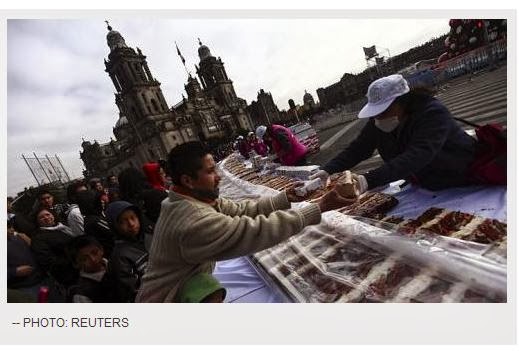
Three Kings in a cake - A Mexican Catholic Christmas tradition

Three Kings in a cake 

A man receiving a piece of a giant roscon de reyes pastry during a Three Kings Day celebration at Zocalo square in Mexico City.
Thousands of Mexicans gathered last Friday to enjoy a piece of the roscon de reyes, or King's Cake, which is provided by Mexico City's government for the New Year, ahead of Three Kings Day tomorrow. The behemoth pastry measured a staggering 1,400m in length and weighed some 9,375kg.
The King's Cake celebration honours the Three Kings' visit to the newborn Jesus when, as Christians believe, God was first revealed to the world in human form.

Published on Jan 05, 2014 
Straits Times 


Tuesday, December 31, 2013

The transforming power of Ruth (Based on a Silent Retreat at the Benedictine Monastery in Snowmass, Colorado)

The transforming power of Ruth

A short story by SUCHEN CHRISTINE LIM


When I first set eyes on Ruth in the monastery, all I saw lying curled like a foetus on the large trestle table was a dark-haired, severely deformed skeletal woman, the size of a nine-year-old. Dressed in thick woollens, she was in a frozen state. She could neither move nor speak a word.


"My daughter, Ruth," Helen, our meditation leader, said.


That year, I'd flown to Denver, Colorado, still seething with anger and resentment. Desperate to leave my heartbreak behind me, I was determined to do a two-week silent meditation retreat in the Benedictine Monastery in Snowmass. I rented a car and drove up the Rocky Mountains to the town of Aspen, 2,400m above sea level.


It was foolhardy. I had never travelled alone. Lawrence wouldn't hear of it. Neither had I driven up any mountain before, so it didn't occur to me that in mid-March it might still be winter in the Rockies.


Halfway up the mountain, it started to snow heavily. The next morning, Aspen was like a scene straight out of a Christmas card, all covered with snow, and Helen was waiting to take me to the monastery.


"Mrs Sarah Verghese?" The stout American woman in a brown leather jacket and boots shook my hand. Her handshake was warm, and so were her grey eyes.


"Here, let me."


With a deft swing, she swung my heavy suitcase into the boot of her large four-wheel drive. I gasped, "You could've hurt your back."


She looked 60-ish, 20 years older than me, yet she had lifted my suitcase as though it was a bag of groceries. "Don't worry. I'm used to it. Shall we go?"


The monastery was in a high valley surrounded by forests and snow-covered hills. There was a dormitory, a chapel, and a few secluded cottages known as hermitages for those who wished to meditate alone. Twenty of us from all walks of life and different parts of the world were to stay in the dormitory. Not all were Catholics.


Some, I discovered later, were Methodists, Calvinists or Presbyterians. The monastery welcomed everyone, but they had to observe one simple rule - silence at all times inside the buildings.


The next morning we were awakened at 4.30 by the gentle ringing of a bell. At 5, we entered the softly lit meditation room. Helenwas already seated on her cushion. On our drive up, she'd told me she lived a few miles down in the village below. I reckoned she would have to get up earlier than 4.30 to drive up the dark mountain road to reach the monastery before 5, and in the bitter cold, too, for it had snowed all night.


We sat on cushions on the floor, and had wrapped ourselves in thick shawls and blankets. One of the walls was glass from floor to ceiling, and I could see that it was pitch black outside when Helen sounded her bell and I closed my eyes.


When I opened them again at the sound of her bell, the sky was still dark. We stood up and walked slowly round the room to stretch our legs before the next sit. A few latecomers straggled in and we sat again for another half an hour till 6. By then, a soft grey light had filtered through the glass wall, and the snow-covered bushes outside were tinged with pink. We filed silently out of the meditation room into the kitchen-cum-dining room where a shock awaited us.


Lying asleep curled on her side on the trestle table was this thin girl-woman who was all skin and bones. We ate our breakfast of freshly baked bread in an uncomfortable silence, using our eyes to ask a neighbour to pass the butter or jam. My own eyes avoided the trestle table.


The severity of the woman's deformity distressed me. I couldn't bear to look at her, and I was ashamed. Ashamed of my distress. I glanced at the others. No one looked at the trestle table. No one went near it that first morning.


That evening, some of us, unable to bear the silence any longer, went out to the garden to talk. A woman who had done the retreat before told us that Ruth was 36 years old, and she was deaf. I went back inside. I didn't want to listen any more. I didn't want to talk about this deformed adult-child. Lawrence had insisted on an abortion when we were told that the foetus inside my womb had grave genetic defects. He didn't want children, he said.


I didn't want to think about Ruth. Yet, her existence could not be denied. Every day, she was among us, curled up on the trestle table as we ate our meals and had our coffee breaks in between the meditation sessions. Every lunch hour, we watched Helen, her mother, carry her like a baby into a private room to feed and change her diaper, and our hearts were filled with pity for Helen. At such moments, I felt Lawrence and I had done the right thing.


On the third morning, I noticed Ruth's dark eyes following us as we moved about the dining room. The next day, I thought her eyes blinked at me as I walked past. It made me stop. When I looked at her, her eyes seemed to smile although not a muscle twitched on her stiff, frozen face.


The next morning, I stood at the trestle table and mouthed a silent "hello". Her eyes seemed to brighten at this, and I was pleased. On the fifth day, I bent down towards her and whispered, "Hi, I'm from Singapore."


From then on, I made it a point to stop by the trestle table like the others to say a few words to Ruth despite having been told that she was deaf.


"I saw a bird outside my window," I told her one morning, and touched her inert hand. The tactile sensation shocked me and I withdrew my hand at once. Her bony fingers were stiff and bent like a dead bird's claw. Although Ruth couldn't see my face since she couldn't turn her head, I felt I had to apologise.


"Sorry, Ruth," I muttered, "I'm not used to touching bones." And had to smile. I sounded corny. Yet, looking into Ruth's eyes, I knew she'd understood my clumsy apology.


Over the next few days I noticed others in my group relating to Ruth with growing familiarity. Like me, they held her hand, patted her and laughed silently with her as though they were in conversation. On the ninth morning while I was whispering something to Ruth, I realised with a shock that I'd stopped seeing her as an ugly twisted human wreck.


"Something has shifted inside me," I whispered to her. "I no longer want to plunge and twist a knife into my husband's heart. Cause him as much pain as he'd caused me. I'm still hurt, but I don't want revenge any more."


By then, I felt that the twisted body on the trestle table did contain a spark of intelligent compassion. Each day I'd found myself stopping a little longer at the table. I could be talking to myself, yet when I looked into Ruth's dark eyes, they seemed to reflect understanding. In fact, Ruth appeared less deformed. No longer a being to be pitied. I could no longer describe her as a skeletal adult foetus. She was a human being. Like me.


Thinking back to those silent days in the dining room of the monastery, I believe that Ruth's daily silent presence forced me to see beyond the physical body. Daily, I saw how Helen carried her 36-year-old daughter like a baby into a private room to feed and change her diaper without fuss as though it was a normal thing to do. Helen's devotion made me see the nature of love with no strings attached. On the last day of the retreat, I plucked up courage to ask Helen about Ruth, and this is their story.


Ruth came from a family of six. Helen was a cook in the monastery before she became our meditation leader. Her father was a carpenter. When the monks first invited Helen to join the monastery's meditation leadership team, she declined because she couldn't leave Ruth at home all day. The monks told her to bring Ruth to the monastery with her.


Later, when the monks discovered that Ruth's presence had a positive effect on those who came for retreat, they made Ruth part of the meditation leadership team, and paid her a monthly stipend. The abbot of the monastery said that Ruth had lessons to teach the rest of us.


Over the years, I'd wondered what lessons we had learnt from Ruth, a human being so utterly helpless and dependent on others like a baby, yet so transformative in her influence on others.


Like a baby.


The writer is the winner of the Singapore Literature Prize and the S.E.A. Write Award.


Copyright © 2014 Singapore Press Holdings. All rights reserved.


Published on Dec 28, 2013

British TV show uncovers lost Van Dyck masterpiece (Purchased by Father Jamie MacLeod)

British TV show uncovers lost Van Dyck masterpiece


Video link - Antiques Roadshow portrait revealed to be by Anthony Van Dyck

LONDON (REUTERS) - A British television show dedicated to valuing people's usually modest antiques said on Sunday that it has uncovered a "hidden masterpiece" worth up to 400,000 pounds (S$385,000).
The painting by 17th-century Flemish artist Anthony van Dyck depicts a bearded Brussels magistrate wearing a ruff and was brought to the show by an English priest who bought it in an antiques shop for only 400 pounds.
Father Jamie MacLeod, who purchased the painting because he liked the thick gold-coloured frame, plans to sell the portrait to fund the restoration of bells at the chapel of a religious retreat he runs in Derbyshire, England.
Philip Mould, an art expert working for the BBC's Antiques Roadshow, had suspected that the painting might be an original Van Dyck, urged the cleric to have the canvas stripped back to its original paintwork and authenticated.
Christopher Brown, one of the world's leading authorities on Van Dyck and director of the Ashmolean Museum in Oxford, was then able to verify that the painting was genuine, the programme said.
The portrait is believed to have been completed as part of Van Dyck's preparation for a larger 1634 work showing seven magistrates. That painting has since been destroyed.
Mould described the find as "a thrilling example" of the skills of direct observation that made Van Dyke such a great portrait painter.
Van Dyck was one of England's leading court painters in the 17th century, making his name with portraits of Charles I of England and his family and court.
Fiona Bruce, a presenter on the BBC show, said she had suspected the canvas was a Van Dyck when she first saw it.
"It's everyone's dream to spot a hidden masterpiece. To discover a genuine Van Dyck is incredibly exciting," she said.
The episode detailing the find is due to be broadcast in Britain on Sunday evening.

Saturday, December 21, 2013

Homilies - The Christmas Story’s Best Supporting Actor

The Christmas Story’s Best Supporting Actor
December 18, 2013 | By Marcellino D’Ambrosio, Ph.D. | Reply
In the drama of the incarnation, Jesus is, of course, the star.  That’s the way it is at every birth.  All eyes are on the baby.  The co-star, though, is definitely mom.  Without her love and labor, the event could not have happened.  In this case, without mom’s faith it couldn’t have happened either.  According to Luke’s Gospel, an angel brought her stunning news.  She believed the unbelievable and said “let it be.”
But there is a best supporting actor in the drama as well.  True, Joseph was not the biological father.  But the messiah had to be of David’s royal line.  In ancient Israel, a child’s clan was determined by that of his father.  So it was Joseph who legally bound Jesus to the house of David.  It was because of Joseph that the family had to go to Bethlehem for the census, that the prophecy might be fulfilled.
God carefully selected the woman who would be the mother of his Son.  But he must have been equally careful in his selection of the foster-father.  For genes are not the only thing parents impart to their children.  Jesus, in his humanity, had to grow in wisdom, age, and grace (Luke 2:52).  Joseph must have responsible for a good deal of this growth.  It was Joseph who was Jesus’ male role model.  From Joseph Jesus learned many things, including the trade that he would practice for some twenty years.
But there are even more important things that Jesus learned from Joseph.  For Joseph was a just man, an honest man, a courageous man, a man of integrity.  His betrothed was pregnant but not by him. Imagine the shame, the hurt, and the anger that he must have experienced assuming what anyone would assume in such a situation.  His integrity would not allow him to marry an adulteress and pretend the child was his.  Neither would he expose the woman he loved to shame and punishment.  He did not procrastinate or waffle.  He made the difficult decision to divorce Mary quietly.
But then came the messenger. In Luke’s Gospel, there was an angelic Annunciation to Mary.  In the first chapter of Matthew, we learn that Joseph gets one too.  He was named after the greatest dreamer of the Old Testament.  Maybe that’s why his annunciation came in a dream.
Mary’s great claim to fame is her faith.  When told the unbelievable, she believed.
Joseph’s claim to fame is also his faith.  He too was also told the unbelievable and dared to believe.  His response of faith entailed taking action – he change his plans, received Mary into his home, and accepted responsibility for this special child.  Keep this in mind, though, that Mary needed no revelation to be sure this was a virginal conception.  All Joseph had to go by was what he received from an angel, in a dream.
Do you think he may have been tempted at some point to second guess this experience, especially when things did not go smoothly?  After all, when a plan is from God, are not doors supposed to open?  Yet when they arrived in Bethlehem, the door of the inn was slammed in their face.  If this were God’s child, wouldn’t God provide a room?  And if this were really God’s son, wouldn’t God have turned back Herod’s hit men?
Then the angel shows up again in another dream: “flee to Egypt with Mary and the baby.”
Wasn’t the 70 mile walk to Bethlehem with a pregnant woman enough?  If this was God’s doing, shouldn’t there be an easier way?
Joseph may or may not have thought these things.  I would have.  The point is, Joseph believed and acted.  And when the angel came a third time and told him to make the long trek back to Nazareth, he acted again.
Joseph certainly did a lot of walking.  From Nazareth to Bethlehem to Egypt and back again.  Paul said we walk by faith, not by sight.  Joseph is a model of faith because he keeps walking, even in the dark.

Editor’s Note: Reflection on the Mass readings for the Fourth Sunday of Advent (Year A) – Isaiah 7:10-14; Psalms 24:1-2, 3-4, 5-6; Romans 1:1-7; Matthew 1:18-24

Friday, December 13, 2013

STAYING AWAKE by Father Ron Rolheiser

STAYING AWAKE by Father Ron Rolheiser 

Theme: Spiritual Sleep and Alertness 

2013-12-08
In his autobiography, Report to Greco, Nikos Kazantzakis recounts a conversation he once had with an old monk.  Kazantzakis, a young man at the time, was visiting a monastery and was very taken by a famed ascetic, Father Makarios, who lived there. But a series of visits with the old monk left him with some ambivalent feelings as well.  The monk's austere lifestyle stirred a certain religious romanticism in Kazantzakis, but it repelled him too; he wanted the romanticism, but in a more-palatable way. Here's their conversation as Kazantzakis records it:

"Yours is a hard life, Father. I too want to be saved. Is there no other way?"

"More agreeable?" asked the ascetic, smiling compassionately.

"More human, Father."

"One, only one."

"What is that?"

"Ascent. To climb a series of steps. From the full stomach to hunger, from the slaked throat to thirst, from joy to suffering. God sits at the summit of hunger, thirst, and suffering; the devil sits at the summit of the comfortable life. Choose."

"I am still young. The world is nice.  I have time to choose."

Reaching out, the old monk touched my knee and said:

"Wake up, my child. Wake up before death wakes you up."

I shuttered and said:

"I am still young."

"Death loves the young," the old man replied. "The inferno loves the young. Life is like a lighted candle, easily extinguished. Take care - wake up!"

Wake up! Wake up before death wakes you up. In a less dramatic expression that's a virtual leitmotif in the Gospels. Jesus is always telling us to wake up, to stay awake, to be vigilant, to be more alert to a deeper reality. What's meant by that? How are we asleep to depth? How are we to wake up and stay awake?

How are we asleep? All of us know how difficult it is for us to be inside the present moment, to not be asleep to the real riches inside our own lives. The distractions and worries of daily life tend to so consume us that we habitually take for granted what's most precious to us, our health, the miracle of our senses, the love and friendships that surround us, and the gift of life itself. We go through our daily lives not only with a lack of reflectiveness and lack of gratitude but with a habitual touch of resentment as well, a chronic, grey depression, Robert Moore calls it. We are very much asleep, both to God and to our own lives.

How do we wake up? Today there's a rich literature that offers us all kinds of advice on how to get into the present moment so as to be awake to the deep riches inside our own lives. While much of this literature is good, little of it is very effective. It invites us to live each day of our lives as if was our last day, but we simply can't do that. It's impossible to sustain that kind of intentionality and awareness over a long period of time. An awareness of our mortality does wake us up, as does a stroke, a heart attack, or cancer; but that heightened-awareness is easier to sustain for a short season of our lives than it is for twenty, thirty, forty, or fifty years. Nobody can sustain that kind of awareness all the time. None of us can live seventy or eighty years as if each day was his or her last day. Or can we?

Spiritual wisdom offers a nuanced answer here: We can and we can't!  On the one hand, the distractions, cares, and pressures of everyday life will invariably have their way with us and we will, in effect, fall asleep to what's deeper and more important inside of life. But it's for this reason that every major spiritual tradition has daily rituals designed precisely to wake us from spiritual sleep, akin an alarm clock waking us from physical sleep.

It's for this reason we need to begin each day with prayer. What happens if we don't pray on a given morning is not that we incur God's wrath, but rather that we tend to miss the morning, spending the hours until noon trapped inside a certain dullness of heart. The same can be said about praying before meals. We don't displease God by not first centering ourselves in gratitude before eating, but we miss out on the richness of what we're doing. Liturgical prayer and the Eucharist have the same intent, among their other intentions. They're meant to, regularly, call us out of a certain sleep.

None of us lives each day of our lives as if it was his or her last day. Our heartaches, headaches, distractions, and busyness invariably lull us to sleep. That's forgivable; it's what it means to be human. So we should ensure that we have regular spiritual rituals, spiritual alarm clocks, to jolt us back awake  - so that it doesn't take a heart attack, a stroke, cancer, or death to wake us up.

Saturday, November 9, 2013

DYING INTO SAFE HANDS

DYING INTO SAFE HANDS by Father Ron Rolheiser
(CROSS REFERENCE WITH 2 MACCABEES 7:1-2, 9-14; 2 THESSALONIANS 2:16-3:5; LUKE 20:27-38) 
2013-11-03
It's hard to say something consoling in the face of death, even when the person who died lived a full life and died in the best of circumstances. It's especially hard when the one who's died is a young person, still in need of nurturing and care in this life, and when that young person dies in less-than-ideal circumstances.

As a priest, I have, a number of times, had to preside at the funeral of someone who died young, either as the result of illness, accident, or suicide. Such a funeral is always doubly sad. I remember one such funeral in particular: A high-school student had died in a car accident. The church was over-packed with his grieving family, friends, and classmates. His mother, still a young woman herself, was in the front pew, heavy with grief about her loss, but clearly weighed-down too with anxiety for her child.  After all, he was still just a boy, partly still in need of someone to take care of him, still needing a mother. She sensed how, dying so young, in effect, orphaned him.

There aren't many words that are helpful in a situation like this, but the few that we have say what needs to be said - even if on that day, when death is still so raw, they don't yet bring much emotional consolation. What's to be said in face of a death like this?  Simply that this young boy is now in more-loving, more-tender, gentler, and safer hands than ours, that there's a mother on the other side to receive him and give him the nurturing he still needs, just as there was one on this side when he was born. No one is born, except into a mother's arms. That's an image we need to keep before us in order to more healthily imagine death.

What, more precisely, is the image? Few images are as primal, and as tender, as that of a mother holding and cradling her new born baby.  Indeed the words of the most-renowned Christmas carol of all time, Silent Night, were inspired by precisely this image. Joseph Mohr, a young priest in Germany, had gone out to a cottage in the woods on the afternoon of Christmas Eve to baptize a new born baby. As he left the cottage, the baby was asleep in its mother's lap.  He was so taken with that image, with the depth and peace it incarnated, that, immediately upon returning to his rectory, he penned the famous lines of Silent Night. His choir director, Franz Gruber, put some guitar chords to those words and froze them in our minds forever. The ultimate archetypal image of peace, safety, and security is that of a new born sleeping in its mother's arms. Moreover, when a baby is born, it's not just the mother who's eager to hold and cradle it. Most everyone else is too.

Perhaps no image then is as apt, as powerful, as consoling, and as accurate in terms of picturing what happens to us when we die and awake to eternal life as is the image of a mother holding and cradling her new born child.  When we die, we die into the arms of God and surely we're received with as much love, gentleness, and tenderness as we were received in the arms of our mothers at birth. Moreover, surely we are even safer there than we were when we were born here on earth. I suspect too that more than a few of the saints will be hovering around, wanting their chance to cuddle the new baby. And so it's okay if we die before we're ready, still in need of nurturing, still needing someone to help take care of us, still needing a mother. We're in safe, nurturing, gentle hands.

That can be deeply consoling because death renders every one of us an orphan and, daily, there are people dying young, unexpectedly, less-than-fully-ready, still in need of care themselves. All of us die, still needing a mother. But we have the assurance of our faith that we will be born into safer and more nurturing hands than our own.

However, consoling as that may be, it doesn't take away the sting of losing a loved one to death.  Nothing takes that away because nothing is meant to. Death is meant to indelibly scar our hearts because love is meant to wound us in that way.  As Dietrich Bonhoeffer puts it: "Nothing can make up for the absence of someone we love. ... It is nonsense to say that God fills the gap; God doesn't fill it, but on the contrary, God keeps it empty and so helps us keep alive our former communion with each other, even at the cost of pain.  ... The dearer and richer our memories, the more difficult the separation. But gratitude changes the pangs of memory into a tranquil joy. The beauties of the past are borne, not as a thorn in the flesh, but as a precious gift in themselves."


Our Friend, Death

OUR FRIEND, DEATH
NOVEMBER 8, 2013 

BY PATTI MAGUIRE ARMSTRONG   (Cross reference with 2 MACCABEES 7:1-2, 9-14; 2 Thessalonians 2:16-3:5; Luke 20:27-38) 

As the saying goes: “Nothing is certain but death and taxes.”  But taxes you can avoid and evade; death–not so.  Therefore, the only logical response to death is to embrace it…or at least accept it.  After all, it’s not like we have a choice.

While traveling back from dropping off a son for college in Oregon a while ago, we attended Mass in Missoula, Montana at St. Francis Xavier Church.  During the prayers of intercession, one prayer caught my attention: “For all who have died, for all who are going to die and for all who are afraid to die.”
That last one–all who are afraid to die–stood out for me.  “Isn’t that just about everyone?” I thought.  Yet, many years ago, I realized there was only one thing to do about death—to make a friend of it and think of it often.

Life through Death
At first glance, thinking of death seems morbid.  Death hardly seems like a cheerful thought for the day.  But I contend that it is just that—or at least it can be a holy way to get through the day. And with holiness comes peace and ultimately joy. The opposite would be to try to deny death. That would be a depressing and hopelessly futile endeavor.  Death is coming for us all so the sooner we make peace with it the sooner we can get on with living.
In the book Amazing Grace for Surivors (Ascension Press) there is a story titled “The Gift of Cancer.”  In it, Richard J. Cusack, Sr. says that God gave him the greatest possible gift. “It was cancer and the fear of dying,” said Cusack. “Through that gift He woke me up and showed me what life is all about and how wonderful it can be when you begin your journey closer to Him.”

Cusack recovered, but during the time he believed he was at death’s doorstep, he prioritized his life very differently than it had been previously and he also began a ministry. “One Friday afternoon at 3:00 p.m. he was sitting in a perpetual adoration chapel, thanking God for all the extra time he had been given. ‘Before I arrive at my final judgment, is there something I can do for you here on earth?’ he asked God. ‘What would be pleasing to you? He suddenly had an inspiration about making a beautiful holy card with a monstrance on the front and the words, ‘Do you really love me? Then come to me. Visit me before the Blessed Sacrament.’” His first printing of 100 cards quickly ran out and requests for more poured in. Since that time, Cusack has distributed tens of thousands of these cards.  It was death that was the inspiration for such living.

Several years ago, I was speaking with Elizabeth “Beth” Matthews, a favorite author of mine who contributed stories to the “Amazing Grace” book series.  She was in the middle of yet another move, dealing with all the usual hassles and then some.  Beth related to me a phone conversation she had with a relative. “In another hundred years we’ll all be dead and none of this will matter,” she had said.

Her relative was taken aback and said, “Oh Beth, don’t say that.”
But Beth responded:  “Why not? It’s true.”
I understand that such a thought is actually not depressing, but freeing. Death puts everything in perspective.  Instead of fretting over some irritation, it reminds us that indeed, soon our life on earth and life’s inconveniences will be nothing to us.  It reminded me of something my mother used to say to me when I was a girl, whenever I was upset over some trivial thing:  “Will it matter in a hundred years from now?”

What if death was on your “to-do” list today?
I once read of a monk that was working in the garden when he was asked what he would do if he had one hour left to live.  The monk calmly stated that he would not do anything differently, he would continue working in the garden.  Many are surprised at such a response since most of us would immediately drop to our knees and pray. But for this monk, he strove to live every moment for God. Thus, he was always ready.

We all know people who spend inordinate amounts of time at work and have many possessions, but don’t go to Mass. If they knew they would come face to face with the Almighty that afternoon, would they change their schedule for the day? Or parents who run their kids all over town for activities, but don’t bother to take them to church on Sunday.  If they suddenly learned their child was going to die very soon, would the priorities change?

Actually had the experience of thinking one of my sons had died.  When my husband Mark and I came upon our 14-year-old son, he was blue and not breathing.  It turned out that he had a seizure and his breathing had been cut off.  We were at a lake at a family reunion and it was the middle of the night.  Our older son heard him struggling to breathe before he lost consciousness. Mark ran next door for help where his brother, a doctor, was staying. During those tense moments, Mark and I prayed separately. My oldest son and I prayed together and another son did CPR, which he had learned at boy scouts.  Mark and I later learned that we prayed with the same thought in mind–that perhaps our son was already gone and it was too late.  While we pleaded with God for to save our beloved son, we also acknowledged our acceptance of God’s will.  Or course it was an emotional situation.  My body shook with shock as I thought with horror that I had not even gotten to say good-bye.

Our son recovered within minutes and never again had another seizure.  But our family was left with the experience of death.  I told the kids we had been blessed for two reasons.  One, our son and brother was still with us and two, we experienced first-hand what it is like to have death come without warning.
I am not in any way trying to lessen the shock and grief one feels over the death of a loved one.  I know it is not a one-time feeling, but something that is grieved over and over again.  But for Mark and me, the fact that we are in touch with eternity and try to live or it, our first reaction to any death is acceptance—even along with the shock and grief.  It is what keeps us grounded and helps us to share the same priorities: God first, everything else second and nothing in the way.

The Divine Jeweler
A few years ago, I heard on the news that former Beatle, George Harrison, had died.  For some reason, on this particular occasion, I was immediately struck by the thought that now he was no different than a cleaning woman.  His soul lay bare while his fame and fortune remained in this world.  The only things he could take with him were the same things we all take with us—the love and service to God and others.

On earth, true value is often clouded by the glitz of the world, but death, like a divine jeweler, appraises life’s true valuables.  I need the help of death to do this for me.  For instance, I could be dropped into any department store onto any aisle (save the tool section) and find things I want to buy.  Linens and towels?  Suddenly mine seem so faded and thin. Furniture? Everywhere I look is something I like.  One thing that helps to douse my materialistic inclinations it so remind myself that life is passing and nothing that I want to buy is of lasting value.

Someone much wiser than I once likened earthly life to a ship:  It is the vessel, not the destination. The only reason we fear death is because we try to make the ship into the destination.  That would be like driving across country in a car and then not wanting to get out once we arrived at our desired location.
Don’t think that I am above fearing death or that I’m looking forward to losing my loved ones.  I simply have come to terms with the fact that God has promised us eternal life and that it will be better than anything we experience on earth. There’s only one way to get there—through death. And we all have to go sometime.

A favorite prayer of mine which keeps me grounded in this reality is “A Workman’s Prayer to St. Joseph”.   Appealing to St. Joseph for a right disposition in our work, it asks for help: “…having always death before my eyes and the account which I must render of time lost, of talents wasted, of good omitted…”

When the inspiration struck for this article, I envisioned that the topic would incite some to imagine me at my computer dressed in black with a humorless expression on my face. Some might wonder what sort of mother I must be to keep death on my thoughts.  But instead, it is life that we strive for in our home. The idea is just not to confine ourselves to life on earth but