Sunday, February 16, 2014

OUR PAGAN RESISTANCE TO THE OTHER WORLD- A PREOCCUPATION WITH WORLDLY PURSUITS

OUR PAGAN RESISTANCE TO THE OTHER WORLD

2014-02-09
Sometimes while presiding at the Eucharist or preaching, I scan the faces in the front pews. What do they reveal? A few are eager, attentive, focused on what's happening, but a goodly number of faces, particularly among the young, speak of boredom, of dram duty, and of a resignation that says: I have to be in the church just now, though I wish I was elsewhere. These reactions are, of course, understandable. We're human after all, flesh and blood, and when we try to focus on the world of spirit or on what relativizes flesh and blood, mortality and self-sacrifice, we can expect that most times the reality of this life will trump the promise of other world.

Sometimes, gazing at those faces staring back at me in church, I'm reminded of a scene that Virginia Woolf describes in her novel, The Waves.  The scene is a chapel in a boarding school in England where one of the churchwardens is giving the students a spiritual admonition during a worship service. This particular churchwarden isn't much respected by the students, but that's not the deepest reason why one student, Neville, is put off by his words, and by what's happening in general in that worship service. Something inside him is in resistance, not just against the words of this particular churchwarden, whom he disrespects, but against the very world of which this churchwarden is speaking. In essence, young Neville's blood is too warm at that moment to find palatable any words that speak of contingency, mortality, abnegation, the cross, silence, or of the other world; instead his youthful blood is silently pressuring for the opposite, health, youth, sex, companionship, status, fame, and pleasure.

And so he seeks a distraction. He doesn't want to see the churchwarden's face, doesn't want to hear his words, doesn't want to hear about God, doesn't want to hear about afterlife, doesn't want to be reminded of human mortality, and doesn't want to hear of sacrifice. Like a drug addict, he needs a fix and, in his case, that means fixating on something powerful enough to be religious, powerful enough to match the other world's offer of eternal life, something worthy of the admiration that he somewhere knows he needs to give to somebody.  And he knows exactly where to look.  He fixes his gaze and his admiration on the one person in that chapel, a young man named Percival, who, to his youthful mind, is a true incarnation of life and a god worthy of being worshipped.  Here's how Woolf describes it:

"The brute menaces my liberty, said Neville, when he prays. Unwarmed by imagination, his words fall cold on my head like paving stones, while the gilt cross heaves on his waistcoat. The words of authority are corrupted by those who speak them. I gibe and mock at this sad religion, at these tremulous, grief-stricken figures advancing, cadaverous and wounded.  ...  Now I will lean sideways as if to scratch my thigh. So I will see Percival. There he sits, upright among the smaller fry. He breathes through his straight nose rather heavily. His blue and oddly inexpressive eyes are fixed with pagan indifference upon the pillar opposite. He would make an admirable churchwarden. He should have a birch and beat little boys for misdemeanors. He is allied with the Latin phrases on the memorial brasses. He sees nothing; he hears nothing. He is remote from us all in a pagan universe. But look how he flicks his hand to the back of his neck. For such gestures one falls hopelessly in love for a lifetime."

I cite this description with more than a little sympathy because I too was once that young boy, Neville, sitting in various religious settings with my heart and mind in resistance, quiet outwardly, squirming inwardly, because I did not want to hear or acknowledge anything that didn't, to my mind, honor the reality I felt so undeniably inside my own blood. I didn't want to be reminded that my health was fragile, that my youth was passing, that this life wasn't central, and that we weren't supposed to be thinking so much about sex.  I didn't want to hear about mortality, that we will all die sometime; I didn't want to hear about the cross, that it's only by dying that we come to life; and I didn't want to be asked to focus attention on the other world, I wanted this world. I accepted that the church was important, but, for me, the sports arena was more real and more alluring. And, like young Neville, I too had my Percivals, certain peers, certain sports idols, and certain movie stars whose enviable bodies and perfect gestures were the life and immortality I, in fact, yearned for and whose lives didn't seem to have the limits of my own.  

But, I think, God likes this kind of youthful resistance, and built it into us. Why?  Because the stronger the resistance, the richer the final harmony.

Friday, January 10, 2014

ON THE DANGERS OF DEFINING OURSELVES by Ron Rolheiser

ON THE DANGERS OF DEFINING OURSELVES

2014-01-05
Given the speed and change in our world today, the oceans of information being given us by the new technologies, the speed with which knowledge now passes through our lives, the increasing specialization and fragmentation inside higher education, and the ever-increasing complexity of our lives, you occasionally hear someone say, usually just after offering an opinion on something: But what do I know anyway? Good question: What do we know anyway?

On the surface this may sound humble and, if sincere, does depict a certain humility; but this kind of admission has a sad underside: What do I know anyway?  Indeed, what can we know amongst all the complexity and sophistication of our world?

Well, we can know our own light, our own moral center, our own heart, our own mystical center. Ultimately we can know what's most real and most precious to us and this is the most important knowledge of all. We can know what's ultimately important. Next to the inchoate knowledge we have of God, knowledge of our own light, of our own moral center, is the most important thing we will ever know. Indeed knowing our own center is intimately intertwined with knowing God.

This is something we need to highlight today because so many forces around us and inside us conspire to deflect us from being awake to and attentive to our own deepest center, that is, from being in touch with who we really are. When we're honest we admit how difficult it is to be genuinely sincere and how difficult it is for us to act out of our real center rather than acting out of ideology, popular opinion, fashion, fad, or out of some prefabricated concept of ourselves that we've ingested from others around us. Often our attitudes and actions do not really reflect who we are. Rather they reflect who are friends are, the newspapers and websites we've read recently, and what newscasts and talks shows draw our attention. Likewise we often understand ourselves more by a persona that was handed to us by our family, our classmates, our colleagues, or our friends than by the reality that's deepest inside us. Beginning from on infancy we ingest various notions of who we are: "You're the bright one! You're the stupid one! You're a rebel! You're timid! You're selfish! You're afraid? You're slow! You've got a quick mind. You're a loser! You're bad! You're good! You're destined for higher things! You'll be a failure!"

And so the challenge is to be more attuned to our own light, to our own moral center, to be more in touch with what's ultimately most real and most precious to us. No small part of that is the challenge to resist self-definition, to not picture ourselves and act out of an image we've ingested of ourselves as a the bright one, the stupid one, the rebel, the timid one, the selfish one, the generous one, the bad one, the good one, the successful one, the failure, the one who needs to say: "But what do I know anyway?" What's the price we pay for doing that?

First, both our compassion and our indignation then become prescribed and selective. We will praise certain people and things and be incensed by other people and other things not because these speak to or speak against what's most precious inside us, but because they speak to or against our image of ourselves. When that happens we not only lose our real selves we also lose our individuality. Ideology, popular opinion, fashion, fad, group-think, and hype, ironically, bury us into a sea of anonymity. In Rene Girard's words: In our desire to be different we all inevitably end up in the same ditch! One needs only to look at any popular fad, such as wearing a baseball cap backwards, to see the truth of this.

How might we healthily define ourselves in a way that doesn't deflect us from being awake to our own light? What kind of self-definition might help free us from ideology? How might we think of ourselves in a way so that image of ourselves that we ingested in childhood might no longer hold us captive in adulthood so that we are strong and healthy enough to not let, as William Stafford says, a simple shrug or a small betrayal break our fragile health and send the horrible errors of childhood storming out to play through the broken dykes?

There's no easy answer, but here's a suggestion: Early on in his ministry, when people were still trying to figure out who he was, they came to John the Baptist and asked him to define himself: "Who are you? They asked: "Are you the Christ? Are you Elijah? Are you a prophet?" John replied that he was none of these. "Who are you then?" they persisted. John's answer: I am a voice crying out in the wilderness! Just that, no more!

Now that's a healthy self-image and a true humility, with no sad underside.

Saturday, January 4, 2014

Three Kings in a cake - A Mexican Catholic Christmas tradition

Three Kings in a cake 

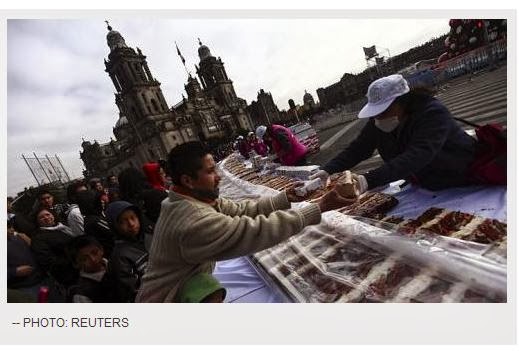
A man receiving a piece of a giant roscon de reyes pastry during a Three Kings Day celebration at Zocalo square in Mexico City.
Thousands of Mexicans gathered last Friday to enjoy a piece of the roscon de reyes, or King's Cake, which is provided by Mexico City's government for the New Year, ahead of Three Kings Day tomorrow. The behemoth pastry measured a staggering 1,400m in length and weighed some 9,375kg.
The King's Cake celebration honours the Three Kings' visit to the newborn Jesus when, as Christians believe, God was first revealed to the world in human form.

Published on Jan 05, 2014 
Straits Times 


Tuesday, December 31, 2013

The transforming power of Ruth (Based on a Silent Retreat at the Benedictine Monastery in Snowmass, Colorado)

The transforming power of Ruth

A short story by SUCHEN CHRISTINE LIM


When I first set eyes on Ruth in the monastery, all I saw lying curled like a foetus on the large trestle table was a dark-haired, severely deformed skeletal woman, the size of a nine-year-old. Dressed in thick woollens, she was in a frozen state. She could neither move nor speak a word.


"My daughter, Ruth," Helen, our meditation leader, said.


That year, I'd flown to Denver, Colorado, still seething with anger and resentment. Desperate to leave my heartbreak behind me, I was determined to do a two-week silent meditation retreat in the Benedictine Monastery in Snowmass. I rented a car and drove up the Rocky Mountains to the town of Aspen, 2,400m above sea level.


It was foolhardy. I had never travelled alone. Lawrence wouldn't hear of it. Neither had I driven up any mountain before, so it didn't occur to me that in mid-March it might still be winter in the Rockies.


Halfway up the mountain, it started to snow heavily. The next morning, Aspen was like a scene straight out of a Christmas card, all covered with snow, and Helen was waiting to take me to the monastery.


"Mrs Sarah Verghese?" The stout American woman in a brown leather jacket and boots shook my hand. Her handshake was warm, and so were her grey eyes.


"Here, let me."


With a deft swing, she swung my heavy suitcase into the boot of her large four-wheel drive. I gasped, "You could've hurt your back."


She looked 60-ish, 20 years older than me, yet she had lifted my suitcase as though it was a bag of groceries. "Don't worry. I'm used to it. Shall we go?"


The monastery was in a high valley surrounded by forests and snow-covered hills. There was a dormitory, a chapel, and a few secluded cottages known as hermitages for those who wished to meditate alone. Twenty of us from all walks of life and different parts of the world were to stay in the dormitory. Not all were Catholics.


Some, I discovered later, were Methodists, Calvinists or Presbyterians. The monastery welcomed everyone, but they had to observe one simple rule - silence at all times inside the buildings.


The next morning we were awakened at 4.30 by the gentle ringing of a bell. At 5, we entered the softly lit meditation room. Helenwas already seated on her cushion. On our drive up, she'd told me she lived a few miles down in the village below. I reckoned she would have to get up earlier than 4.30 to drive up the dark mountain road to reach the monastery before 5, and in the bitter cold, too, for it had snowed all night.


We sat on cushions on the floor, and had wrapped ourselves in thick shawls and blankets. One of the walls was glass from floor to ceiling, and I could see that it was pitch black outside when Helen sounded her bell and I closed my eyes.


When I opened them again at the sound of her bell, the sky was still dark. We stood up and walked slowly round the room to stretch our legs before the next sit. A few latecomers straggled in and we sat again for another half an hour till 6. By then, a soft grey light had filtered through the glass wall, and the snow-covered bushes outside were tinged with pink. We filed silently out of the meditation room into the kitchen-cum-dining room where a shock awaited us.


Lying asleep curled on her side on the trestle table was this thin girl-woman who was all skin and bones. We ate our breakfast of freshly baked bread in an uncomfortable silence, using our eyes to ask a neighbour to pass the butter or jam. My own eyes avoided the trestle table.


The severity of the woman's deformity distressed me. I couldn't bear to look at her, and I was ashamed. Ashamed of my distress. I glanced at the others. No one looked at the trestle table. No one went near it that first morning.


That evening, some of us, unable to bear the silence any longer, went out to the garden to talk. A woman who had done the retreat before told us that Ruth was 36 years old, and she was deaf. I went back inside. I didn't want to listen any more. I didn't want to talk about this deformed adult-child. Lawrence had insisted on an abortion when we were told that the foetus inside my womb had grave genetic defects. He didn't want children, he said.


I didn't want to think about Ruth. Yet, her existence could not be denied. Every day, she was among us, curled up on the trestle table as we ate our meals and had our coffee breaks in between the meditation sessions. Every lunch hour, we watched Helen, her mother, carry her like a baby into a private room to feed and change her diaper, and our hearts were filled with pity for Helen. At such moments, I felt Lawrence and I had done the right thing.


On the third morning, I noticed Ruth's dark eyes following us as we moved about the dining room. The next day, I thought her eyes blinked at me as I walked past. It made me stop. When I looked at her, her eyes seemed to smile although not a muscle twitched on her stiff, frozen face.


The next morning, I stood at the trestle table and mouthed a silent "hello". Her eyes seemed to brighten at this, and I was pleased. On the fifth day, I bent down towards her and whispered, "Hi, I'm from Singapore."


From then on, I made it a point to stop by the trestle table like the others to say a few words to Ruth despite having been told that she was deaf.


"I saw a bird outside my window," I told her one morning, and touched her inert hand. The tactile sensation shocked me and I withdrew my hand at once. Her bony fingers were stiff and bent like a dead bird's claw. Although Ruth couldn't see my face since she couldn't turn her head, I felt I had to apologise.


"Sorry, Ruth," I muttered, "I'm not used to touching bones." And had to smile. I sounded corny. Yet, looking into Ruth's eyes, I knew she'd understood my clumsy apology.


Over the next few days I noticed others in my group relating to Ruth with growing familiarity. Like me, they held her hand, patted her and laughed silently with her as though they were in conversation. On the ninth morning while I was whispering something to Ruth, I realised with a shock that I'd stopped seeing her as an ugly twisted human wreck.


"Something has shifted inside me," I whispered to her. "I no longer want to plunge and twist a knife into my husband's heart. Cause him as much pain as he'd caused me. I'm still hurt, but I don't want revenge any more."


By then, I felt that the twisted body on the trestle table did contain a spark of intelligent compassion. Each day I'd found myself stopping a little longer at the table. I could be talking to myself, yet when I looked into Ruth's dark eyes, they seemed to reflect understanding. In fact, Ruth appeared less deformed. No longer a being to be pitied. I could no longer describe her as a skeletal adult foetus. She was a human being. Like me.


Thinking back to those silent days in the dining room of the monastery, I believe that Ruth's daily silent presence forced me to see beyond the physical body. Daily, I saw how Helen carried her 36-year-old daughter like a baby into a private room to feed and change her diaper without fuss as though it was a normal thing to do. Helen's devotion made me see the nature of love with no strings attached. On the last day of the retreat, I plucked up courage to ask Helen about Ruth, and this is their story.


Ruth came from a family of six. Helen was a cook in the monastery before she became our meditation leader. Her father was a carpenter. When the monks first invited Helen to join the monastery's meditation leadership team, she declined because she couldn't leave Ruth at home all day. The monks told her to bring Ruth to the monastery with her.


Later, when the monks discovered that Ruth's presence had a positive effect on those who came for retreat, they made Ruth part of the meditation leadership team, and paid her a monthly stipend. The abbot of the monastery said that Ruth had lessons to teach the rest of us.


Over the years, I'd wondered what lessons we had learnt from Ruth, a human being so utterly helpless and dependent on others like a baby, yet so transformative in her influence on others.


Like a baby.


The writer is the winner of the Singapore Literature Prize and the S.E.A. Write Award.


Copyright © 2014 Singapore Press Holdings. All rights reserved.


Published on Dec 28, 2013

British TV show uncovers lost Van Dyck masterpiece (Purchased by Father Jamie MacLeod)

British TV show uncovers lost Van Dyck masterpiece


Video link - Antiques Roadshow portrait revealed to be by Anthony Van Dyck

LONDON (REUTERS) - A British television show dedicated to valuing people's usually modest antiques said on Sunday that it has uncovered a "hidden masterpiece" worth up to 400,000 pounds (S$385,000).
The painting by 17th-century Flemish artist Anthony van Dyck depicts a bearded Brussels magistrate wearing a ruff and was brought to the show by an English priest who bought it in an antiques shop for only 400 pounds.
Father Jamie MacLeod, who purchased the painting because he liked the thick gold-coloured frame, plans to sell the portrait to fund the restoration of bells at the chapel of a religious retreat he runs in Derbyshire, England.
Philip Mould, an art expert working for the BBC's Antiques Roadshow, had suspected that the painting might be an original Van Dyck, urged the cleric to have the canvas stripped back to its original paintwork and authenticated.
Christopher Brown, one of the world's leading authorities on Van Dyck and director of the Ashmolean Museum in Oxford, was then able to verify that the painting was genuine, the programme said.
The portrait is believed to have been completed as part of Van Dyck's preparation for a larger 1634 work showing seven magistrates. That painting has since been destroyed.
Mould described the find as "a thrilling example" of the skills of direct observation that made Van Dyke such a great portrait painter.
Van Dyck was one of England's leading court painters in the 17th century, making his name with portraits of Charles I of England and his family and court.
Fiona Bruce, a presenter on the BBC show, said she had suspected the canvas was a Van Dyck when she first saw it.
"It's everyone's dream to spot a hidden masterpiece. To discover a genuine Van Dyck is incredibly exciting," she said.
The episode detailing the find is due to be broadcast in Britain on Sunday evening.

Saturday, December 21, 2013

Homilies - The Christmas Story’s Best Supporting Actor

The Christmas Story’s Best Supporting Actor
December 18, 2013 | By Marcellino D’Ambrosio, Ph.D. | Reply
In the drama of the incarnation, Jesus is, of course, the star.  That’s the way it is at every birth.  All eyes are on the baby.  The co-star, though, is definitely mom.  Without her love and labor, the event could not have happened.  In this case, without mom’s faith it couldn’t have happened either.  According to Luke’s Gospel, an angel brought her stunning news.  She believed the unbelievable and said “let it be.”
But there is a best supporting actor in the drama as well.  True, Joseph was not the biological father.  But the messiah had to be of David’s royal line.  In ancient Israel, a child’s clan was determined by that of his father.  So it was Joseph who legally bound Jesus to the house of David.  It was because of Joseph that the family had to go to Bethlehem for the census, that the prophecy might be fulfilled.
God carefully selected the woman who would be the mother of his Son.  But he must have been equally careful in his selection of the foster-father.  For genes are not the only thing parents impart to their children.  Jesus, in his humanity, had to grow in wisdom, age, and grace (Luke 2:52).  Joseph must have responsible for a good deal of this growth.  It was Joseph who was Jesus’ male role model.  From Joseph Jesus learned many things, including the trade that he would practice for some twenty years.
But there are even more important things that Jesus learned from Joseph.  For Joseph was a just man, an honest man, a courageous man, a man of integrity.  His betrothed was pregnant but not by him. Imagine the shame, the hurt, and the anger that he must have experienced assuming what anyone would assume in such a situation.  His integrity would not allow him to marry an adulteress and pretend the child was his.  Neither would he expose the woman he loved to shame and punishment.  He did not procrastinate or waffle.  He made the difficult decision to divorce Mary quietly.
But then came the messenger. In Luke’s Gospel, there was an angelic Annunciation to Mary.  In the first chapter of Matthew, we learn that Joseph gets one too.  He was named after the greatest dreamer of the Old Testament.  Maybe that’s why his annunciation came in a dream.
Mary’s great claim to fame is her faith.  When told the unbelievable, she believed.
Joseph’s claim to fame is also his faith.  He too was also told the unbelievable and dared to believe.  His response of faith entailed taking action – he change his plans, received Mary into his home, and accepted responsibility for this special child.  Keep this in mind, though, that Mary needed no revelation to be sure this was a virginal conception.  All Joseph had to go by was what he received from an angel, in a dream.
Do you think he may have been tempted at some point to second guess this experience, especially when things did not go smoothly?  After all, when a plan is from God, are not doors supposed to open?  Yet when they arrived in Bethlehem, the door of the inn was slammed in their face.  If this were God’s child, wouldn’t God provide a room?  And if this were really God’s son, wouldn’t God have turned back Herod’s hit men?
Then the angel shows up again in another dream: “flee to Egypt with Mary and the baby.”
Wasn’t the 70 mile walk to Bethlehem with a pregnant woman enough?  If this was God’s doing, shouldn’t there be an easier way?
Joseph may or may not have thought these things.  I would have.  The point is, Joseph believed and acted.  And when the angel came a third time and told him to make the long trek back to Nazareth, he acted again.
Joseph certainly did a lot of walking.  From Nazareth to Bethlehem to Egypt and back again.  Paul said we walk by faith, not by sight.  Joseph is a model of faith because he keeps walking, even in the dark.

Editor’s Note: Reflection on the Mass readings for the Fourth Sunday of Advent (Year A) – Isaiah 7:10-14; Psalms 24:1-2, 3-4, 5-6; Romans 1:1-7; Matthew 1:18-24

Friday, December 13, 2013

STAYING AWAKE by Father Ron Rolheiser

STAYING AWAKE by Father Ron Rolheiser 

Theme: Spiritual Sleep and Alertness 

2013-12-08
In his autobiography, Report to Greco, Nikos Kazantzakis recounts a conversation he once had with an old monk.  Kazantzakis, a young man at the time, was visiting a monastery and was very taken by a famed ascetic, Father Makarios, who lived there. But a series of visits with the old monk left him with some ambivalent feelings as well.  The monk's austere lifestyle stirred a certain religious romanticism in Kazantzakis, but it repelled him too; he wanted the romanticism, but in a more-palatable way. Here's their conversation as Kazantzakis records it:

"Yours is a hard life, Father. I too want to be saved. Is there no other way?"

"More agreeable?" asked the ascetic, smiling compassionately.

"More human, Father."

"One, only one."

"What is that?"

"Ascent. To climb a series of steps. From the full stomach to hunger, from the slaked throat to thirst, from joy to suffering. God sits at the summit of hunger, thirst, and suffering; the devil sits at the summit of the comfortable life. Choose."

"I am still young. The world is nice.  I have time to choose."

Reaching out, the old monk touched my knee and said:

"Wake up, my child. Wake up before death wakes you up."

I shuttered and said:

"I am still young."

"Death loves the young," the old man replied. "The inferno loves the young. Life is like a lighted candle, easily extinguished. Take care - wake up!"

Wake up! Wake up before death wakes you up. In a less dramatic expression that's a virtual leitmotif in the Gospels. Jesus is always telling us to wake up, to stay awake, to be vigilant, to be more alert to a deeper reality. What's meant by that? How are we asleep to depth? How are we to wake up and stay awake?

How are we asleep? All of us know how difficult it is for us to be inside the present moment, to not be asleep to the real riches inside our own lives. The distractions and worries of daily life tend to so consume us that we habitually take for granted what's most precious to us, our health, the miracle of our senses, the love and friendships that surround us, and the gift of life itself. We go through our daily lives not only with a lack of reflectiveness and lack of gratitude but with a habitual touch of resentment as well, a chronic, grey depression, Robert Moore calls it. We are very much asleep, both to God and to our own lives.

How do we wake up? Today there's a rich literature that offers us all kinds of advice on how to get into the present moment so as to be awake to the deep riches inside our own lives. While much of this literature is good, little of it is very effective. It invites us to live each day of our lives as if was our last day, but we simply can't do that. It's impossible to sustain that kind of intentionality and awareness over a long period of time. An awareness of our mortality does wake us up, as does a stroke, a heart attack, or cancer; but that heightened-awareness is easier to sustain for a short season of our lives than it is for twenty, thirty, forty, or fifty years. Nobody can sustain that kind of awareness all the time. None of us can live seventy or eighty years as if each day was his or her last day. Or can we?

Spiritual wisdom offers a nuanced answer here: We can and we can't!  On the one hand, the distractions, cares, and pressures of everyday life will invariably have their way with us and we will, in effect, fall asleep to what's deeper and more important inside of life. But it's for this reason that every major spiritual tradition has daily rituals designed precisely to wake us from spiritual sleep, akin an alarm clock waking us from physical sleep.

It's for this reason we need to begin each day with prayer. What happens if we don't pray on a given morning is not that we incur God's wrath, but rather that we tend to miss the morning, spending the hours until noon trapped inside a certain dullness of heart. The same can be said about praying before meals. We don't displease God by not first centering ourselves in gratitude before eating, but we miss out on the richness of what we're doing. Liturgical prayer and the Eucharist have the same intent, among their other intentions. They're meant to, regularly, call us out of a certain sleep.

None of us lives each day of our lives as if it was his or her last day. Our heartaches, headaches, distractions, and busyness invariably lull us to sleep. That's forgivable; it's what it means to be human. So we should ensure that we have regular spiritual rituals, spiritual alarm clocks, to jolt us back awake  - so that it doesn't take a heart attack, a stroke, cancer, or death to wake us up.